A Frenchman in Singapore
I've been living in Singapore for several months now. Here, there are 4 different official languages: English, Chinese, Malay and Tamil. This blog/website will help me practice my French, English and Chinese by telling you about my life here.

Location
For those of you reeaally bad at geography, just know that Singapore is halfway between China and Australia. Let me be more precise: head south of China and you'll find Myanmar (aka Burma), Vietnam, Laos, then even further south Cambodia, Thailand, and, at the end of a looong peninsula, Malaysia. And at the extreme end of the Malay Peninsula, connected by two bridges, sits the main island of Singapore: Pulau Ujong. Pulau Ujong translates quite aptly to "the island at the end".Careful! If you say to a Singaporean he's living in Pulau Ujong, he'll look at you with round eyes. Singapore has 64 islands but only 3 are residential: Sentosa (an amusement park/seaside resort/ultra luxury residences), Pulau Ubin (a nature park with a very small traditional village), and the big one, where 99.99% of people live, Pulau Ujong, but everybody will simply say "Singapore". Attention ! Si vous dites à un Singapourien qu'il vit sur Pulau Ujong il risque de vous regarder avec des yeux ronds. Singapour compte 64 îles, mais seulement 3 sont habitées : Sentosa (une île parc d'attraction/station balnéaire avec péage à l'entrée), Pulau Ubin (un parc naturel avec un seul minuscule village traditionnel) et, donc, la grande, celle où vivent 99% des gens, Pulau Ujong, mais tout le monde dira simplement "Singapour".
Further south lie thousand Indonesian islands, and, even more meridional, a five-hour flight away, Australia.
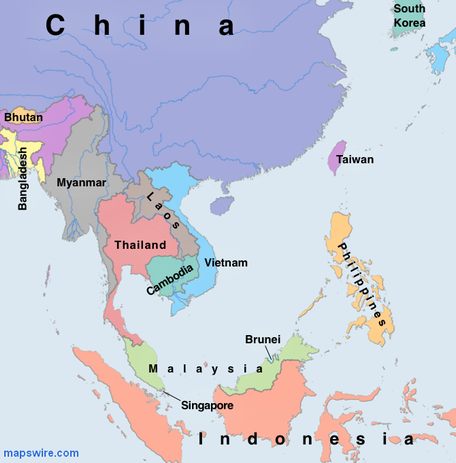
Maybe it'll be easier if I show you a map.
Abridged history
In the 19th century, there were about a thousand people living on the island, far from the current 6 million souls. It was during this century that the British colonial administrator Sir Stamford Raffles Raffles, drawn to its drinkable water sources, wood resources, depth of its bay and location between India and China, decided to establish a British port. You can still find the Raffles name everywhere now: there is a Raffles hotel, a Raffles hospital, a Raffles metro station of course, several Raffles schools, a Raffles supermarket and even a Raffles pet food store.From there, Singapore got bigger and bigger. In 30 years, the territory grew to 60,000 inhabitants (half of them from China), became a proper colony before finally breaking free in 1963. A brief union with Malaysia failed (because the Malaysian government insisted on a system of political privileges for ethnic Malays, which was unacceptable to Singapore's Chinese majority), leading to full independence in 1965.
The country developed quickly under the resolute leadership of its prime minister, Lee Kuan Yew, and has advanced at a rapid pace toward modernity in 40 short years.
03 july 2026, from the 19 juin 2026 French version - Paul